
Doctors
The rationale for Gliovac, its mechanism of action, results so far, and how to donate tumour tissue.
Rationale to use Gliovac/ERC1671/SITOIGANAP

Glioblastoma treatment - Gliovac/ERC1671/SITOIGANAP early access program
Patients facing serious illnesses and who have exhausted all available treatment options often want to know if and how they can receive early access to investigational products that haven’t yet been approved by government regulatory agencies. ERC is committed to making its products available to patients, when appropriate, throughout the development process.
ERC believes participating in clinical trials is the best way for patients to access medicines prior to approval. In pursuit of ERC’s objective to develop highly effective and safe therapeutic approaches, the successful completion of a clinical trial program of investigational products is the most effective way of ensuring timely review and decision-making by government regulatory agencies. This will ultimately result in access to new, safe and effective approved therapies for patients. For these reasons, ERC prioritizes access to its investigational products through active and accruing clinical trials and encourages interested patients to enroll.
Early Access to GLIOVAC/ERC1671/SITOIGANAP
Despite best efforts, it is not possible for all patients to participate in clinical trials. For that reason, ERC has established an early access program in a number of regions.
In the U.S., Right-to-Try (RTT) can be used to make promising products available to patients facing serious or life-threatening conditions. An eligible physician may request access to one of ERC’s investigational products by completing the ERC Right to Try Request Form. For more information please contact Benjamin Freilich MD benfmd@erc-usa.com
In Australia, Category A of the TGA Special Access Scheme (SAS) can be used to make promising products available to patients facing serious or life-threatening conditions. An eligible physician may request access to one of ERC’s investigational products by completing the ERC Special Access Scheme Request Form.
Requests for further information about how to apply for RTT or SAS or determine qualifications and capabilities required to administer ERC investigational product can be made to medicalaffairs@erc-immunotherapy.com
ERC is also willing to consider early access requests outside of these regions.
ERC typically will acknowledge receipt of a request, with required medical documentation, within three business days. ERC professionals will carefully consider requests taking into account access to open and accruing clinical trials, the serious/life-threatening nature of the disease, biological rational or clinical data supporting potential benefit medical appropriateness, and applicable laws and regulatory requirements. All physicians who receive ERC investigational product through RTT or SAS are required to comply with all applicable laws and regulations, and contractual conditions, including those related to safety reporting.
ERC’s Right to Try Policy can be found here.
ERC’s Special Access Scheme Policy can be found here.
The scientific staff
The clinical trials sponsored by ERC are carried out according to International Conference on Harmonisation (ICH) and the WHO Good Clinical Practice (GCP) standards. Compliance with Good Clinical Practice provides assurance that the rights, safety and well-being of trial subjects are protected, and that the results of the clinical trials are credible and accurate. Clinical trials are performed in compliance with the protocol given approval/favourable opinion by the ethical committee and the appropriate regulatory authority(ies).
For more info visit the scientific staff page.
Action mechanism of Gliovac/ERC1671/SITOIGANAP
The product is composed of three different allogeneic cancer cell and lysates preparations (called an allogenic vaccine) from three different donors (donor A, B and C), and autologous cells and lysates, preparated from the patient (patient D). When allogeneic specific cancer cells are inoculated into the patient, the immune system will recognise the component as non-self and induce an allo-immune rejection. The immune cells will be activated against allogeneic components including the specific tumour associated antigens (TAA), which are less or not prevalent on normal non-cancer cells.
By using non-proliferative cancer cell transplantation, it is not just one cancer-related antigen, but a whole set of tumour antigens associated to the glioblastoma, that is inoculated.
By using three different donors, the set of TAA is even broader. Injection of the autologous vaccine preparation will amplify the response of immune cells targeting the TAA present in the patient that is treated.
Upon activation, effector lymphocytes of the immune system are able to identify non-self tumour antigens and destroy the cancer cells that carry these antigens. The immune cells will proliferate and ensure the surveillance within the body, the cancer cells detection, their destruction and eventually patient recovery and immune resistance against the tumor.
Gliovac/ERC1671/SITOIGANAP is an advanced immunotherapy based on transplantation of tumour cells and lysates in order to stimulate immunity to reject cancer cells [endif]--(Stathopoulos et al. 2008; Stathopoulos A 2012b, 2012a, Bota et al., 2015; Schijns et al., 2015). Gliovac/ERC1671/SITOIGANAP is a cancer treatment composed of a combination treatment consisting of autologous glioma tumor cells, and allogeneic glioma tumour cells, generated from three different glioma donor cancer patients, and the lysates of all of these cells. Upon intradermal administration of glioma cancer treatment Gliovac/ERC1671/SITOIGANAP, the mixture of the autologous and allogeneic vaccine (cells and lysates) stimulates the immune system to mount an immune response against glioma tumour-associated antigens, which leads to the destruction of glioma tumour cells.
Visible results after 4 weeks of vaccination

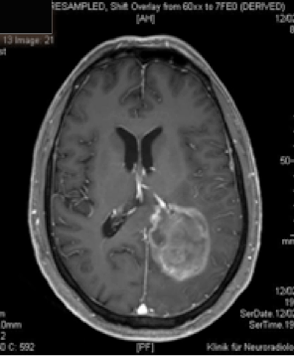
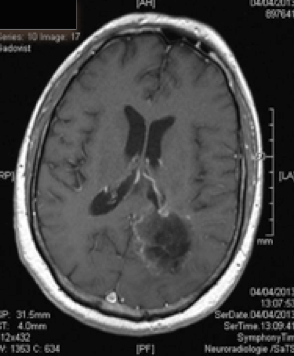
Scans of a patient before and after treatment.
Donation of tumour tissue
If you are interested, please contact us and we will provide you with a transport kit and instructions for the patient and the treating physician according to EU regulation for tissue donation to the TTB-NL.
Gliovac/ERC1671/SITOIGANAP : an anti-cancer immunotherapy – product and progress
ERC has reported success in the development of a therapeutic immune responses in glioblastoma tumour patients, manifested by tumour reduction. Primary results on patients at the advance stage of their illness show that the Gliovac/ERC1671/SITOIGANAP therapy can be protective in early and advanced malignant glioma and is able to break anti-tumour immune tolerance. The approach has been also successfully tested and described in a feasibility first-in-man study. [Bota et al., 2015, Schijns et al., 2015].
This double blinded, randomised, two-arm phase II study is performed at the University of California Irvine, currently updating to add the two clinical centres, including of Dana Faber Cancer centre (Boston) and the University of Southern California. This study compares the standard treatment for recurrent glioma in the USA with the product ERC1671 (Gliovac/ERC1671/SITOIGANAP) in 86 patients, and is currently recruiting patients.
The scientific approach of ERC is supported by confirming letters of eminent Professors from Pittsburg University, John Hopkins Cancer Center and Harvard who are well experienced in the field of glioma tumour therapies.
Recently, the ERC has been granted of a “Seal of Excellence” certificate by the European Commission in a highly competitive evaluation process.
Eventually Gliovac/ERC1671 may not only complement, but even replace existing treatments post surgery and become (part of) the standard treatment. Also, our initial indication is glioma, but it is very likely that the patented concept of the Gliovac/ERC1671 approach can be further utilised for the treatment of other solid tumours, which are surgically treated.